Annual Crops: an Excellent Way to Increase Your Feeding Flexibility
Supplement Perennials With Annuals
Annual crops are an effective tool for resting and recovering perennial pastures, improving long‑term productivity, and increasing feeding flexibility. They can be used strategically in drought years, incorporated as a routine part of a grazing system, or included in a planned annual–perennial rotation to increase the total area available for grazing.
Annuals can typically be grazed 4–6 weeks after spring seeding, while fall‑seeded winter cereals can be grazed as early as mid‑May. Choosing annuals based on their growth stage and intended timing of use helps optimize forage availability throughout the season.
Delaying spring grazing on perennial pastures increases fall grazing capacity; each day of delay can return three additional grazing days in autumn.
Annual crops harvested as greenfeed often provide higher quality feed than perennial hay. Cutting at the soft‑dough stage maximizes protein content, whereas cutting at the hard‑dough stage maximizes yield. Annual cereals also perform well as silage crops and can extend the grazing season in both early spring and late fall.
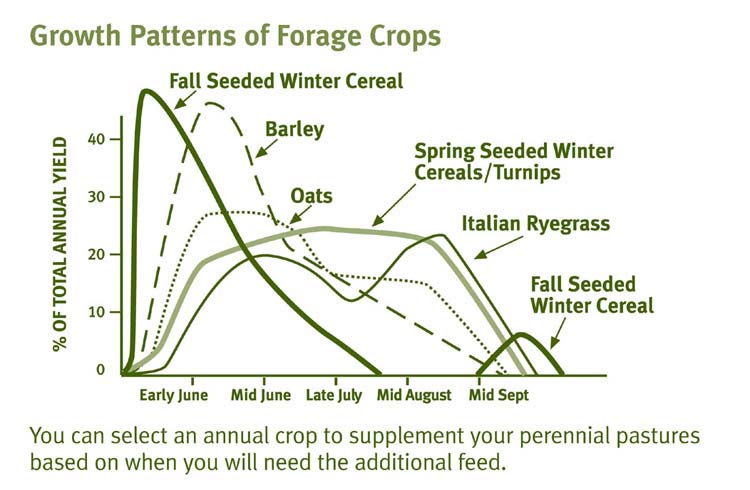
Crop Selection
Annual crops use water 20–50% more efficiently than perennials. Warm‑season annuals—such as corn, millet, sorghum, and sorghum‑sudan hybrids—are typically more water‑ and fertilizer‑efficient than cool‑season annuals.
Crops for Grazing
Annuals can be grazed and later harvested for greenfeed or silage, depending on livestock needs and crop growth stage. To avoid yield losses, avoid grazing or cutting below the plant’s growing point.
Crops for Greenfeed or Silage
Annuals produce high‑quality greenfeed and silage, particularly when cut at the recommended growth stages. Early seeding improves yield potential; crops seeded in May outperform those seeded later. Longer‑maturing crops typically produce higher yields.
Nitrate Considerations
Annual crops are more prone to nitrate accumulation, especially under high nitrogen fertility or stress (drought or cold). High nitrate levels can lead to nitrite poisoning in livestock.
Management recommendations:
- Test crops for nitrate levels before grazing or harvesting for greenfeed.
- Avoid grazing or cutting immediately after stress events, such as drought followed by rain.
- Ensiling can help reduce nitrate concentration in harvested forage.
- Feed test bags and support are available from Manitoba Agriculture and Resource Development Service Centres.
Polycrops and Crop Mixes
Seeding mixtures of species can improve resilience, yield, and forage quality. Crop mixes:
- Extend the grazing season into fall
- Improve soil cover and reduce erosion
- Enhance soil health through diversified rooting systems
Common additions include turnips, radish, annual ryegrass, and sweet clover, blended with cereals and legumes such as barley/peas or oats/peas.
Production Tips
Fertility
Annual forage crops require adequate fertility to support yield and forage quality. Apply nutrients based on soil test results and expected yields.
- Nitrogen supports yield and quality but increases nitrate risk under stress.
- Phosphorus, potassium, and sulfur may also be needed.
- Potassium is particularly important for the overwintering of fall‑seeded cereals.
- Well‑fertilized crops are more resilient to drought, disease, and pests.
Maturity
As plants mature:
- Yield and energy increase until the dough stage.
- Fiber content increases, reducing digestibility.
- Protein content peaks before the boot stage and declines thereafter.
Because supplemental protein is relatively inexpensive, harvesting at or near the dough stage is widely recommended for optimal yield and feeding value.
Managing Grazing
Annual pastures benefit from rotational grazing just like perennials. Research shows that grazing one week on, three weeks off maximizes yield and regrowth.
Cereals grazed weekly or biweekly show significantly reduced productivity compared to those given longer rest periods.