

Consultation
Current Status
Fall 2024 into 2025
The Manitoba government has carried out the following efforts to consult with Indigenous Nations, Rightsholders, communities, and stakeholders:
- Completed Socio-Economic and Well-Being Studies (SEWB) and Rights Impact Assessments (RIA) on potentially affected Indigenous Nations.
- Shared proposed accommodations arising from these studies with Indigenous Nations for feedback.
- Began working on a Memorandum of Understanding (MOU) with the Interlake Reserves Tribal Council to foster a positive and respectful government-to-government relationship, allowing parties to work collaboratively towards meaningful engagement, consultation and accommodation in relation to the proposed project.
- Hired a consultation facilitator who will be attending the What We Heard (WWH) meetings with the potentially affected Indigenous Nations.
2023-2024
- Facilitated fourteen key meetings with the ten Indigenous Nations identified as “potentially most affected.” This included four meetings specifically regarding Indigenous cultural and heritage resources.
Why Consult
The Manitoba government is committed to fostering meaningful relationships with Indigenous Nations to address, avoid, and reduce potential effects on Indigenous Nations and potentially impacted communities. The Manitoba government recognizes that Indigenous Nations have the right to be informed about the impacts that a project may have on Aboriginal and Treaty rights. Indigenous Nations have the right to express their views about the project and its impacts and have those views be given serious consideration and mitigated where appropriate.
The Manitoba government is responsible for two separate but inter-related processes:
Proponent Engagement
- This process is required for federal and provincial environmental authorizations. It gathers information in support of provincial and federal regulatory decisions about impacts to Aboriginal and Treaty rights.
- Manitoba Transportation and Infrastructure is the proponent. As proponent, the department must engage with potentially affected Indigenous Nations to assist in fulfilling the federal Crown’s constitutional obligations and to fulfil the regulatory requirements for developing a complete Environmental Impact Statement.
- The federal government reviews the information Manitoba Transportation and Infrastructure submits. This includes the Environmental Impact Statement and other supplementary information provided throughout the environmental assessment process.
Find out more information about the federal process.
Crown-Indigenous Consultation
- As the provincial Crown, the Manitoba government is responsible under Section 35 of Canada’s constitution to consult with Indigenous groups or communities whose exercise of treaty or Aboriginal rights might be affected by a government decision or action related to the project.
- Before construction on the Lake Manitoba and Lake St. Martin outlet channels can begin, both the Manitoba government and the federal government have a legal duty to consult Indigenous Nations potentially affected by the project.
- The intent of Crown-Indigenous consultation is to provide meaningful opportunities for potentially affected Indigenous Nations to receive information about the proposed project. Indigenous Nations also have the opportunity to share information, concerns, and comments about the project and to provide feedback on the information the Crown developed.
The Consultation Process
The provincial Crown-Indigenous consultation process for the project was developed by Manitoba Transportation and Infrastructure with guidance and direction from a Steering Committee with representation from several Manitoba government departments. In 2025, the responsibilities of those departments fall under the Departments of Agriculture, Transportation and Infrastructure, Justice, Municipal and Northern Relations, and Natural Resources and Indigenous Futures.
There are four phases in the provincial Crown-Indigenous consultation process:
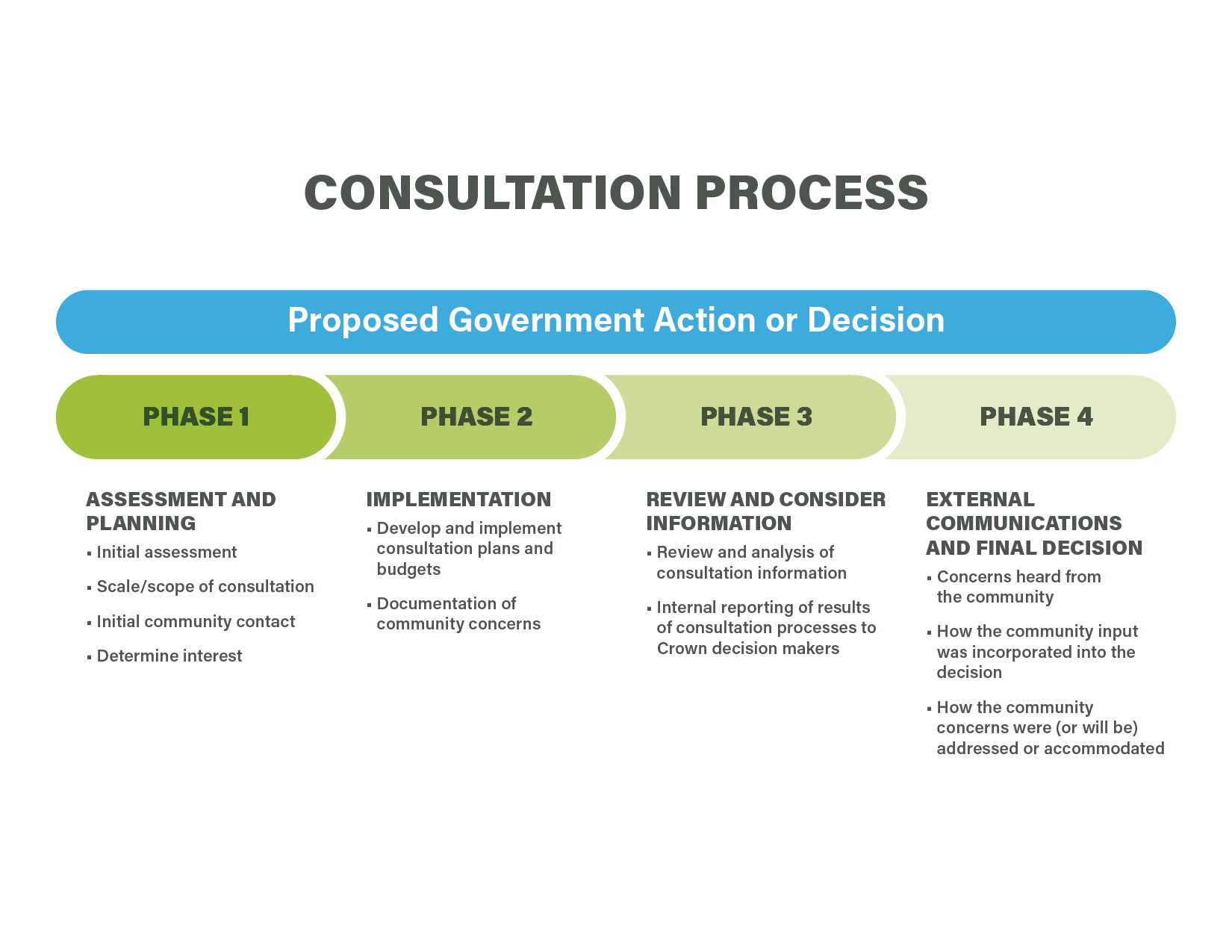
The Manitoba government undertakes an initial assessment of its duty for Crown-Indigenous consultation, and determines if there is a duty to consult, which Indigenous Nations need to be consulted, and at what level the consultation should take place. It considers the following:
- Proximity to the project footprint
- Potential environmental impacts
- Our current understanding of traditional land use.
The Manitoba government’s initial assessment is reviewed on an ongoing basis when additional information is received.
Manitoba Transportation and Infrastructure is currently in Phase 3 of the Consultation process. This is the review phase where MTI will consider all consultation information which has been gathered through intensive meetings and engagements with Indigenous Nations. This information has also been shared with Indigenous Nations through What We Heard packages to ensure that Project-related concerns have been accurately captured in these meetings.
Public Engagement
The Manitoba government also recognizes that all Manitobans have an interest in water management throughout the province. Water management is a highly technical and complex field, and the consequences of various activities can be significant. This proposed project presents an opportunity to both educate the public and provide the public with opportunities to discuss their concerns.
Members of the public will continue to have additional opportunities to provide feedback through the provincial and federal environmental authorization processes. Questions and comments about the project can be directed to outletchannels@gov.mb.ca.
Past Consultation and Engagement Activities
Proposed Lake Manitoba Lake St. Martin Outlet Channels Project Open Houses – 2017-2019
- Assiniboine River and Lake Manitoba Basins Flood Mitigation Study – 2012 commissioned to assess several flood mitigation projects, including the Lake Manitoba and Lake St. Martin outlet channels project. Open house storyboards are available online.
- June and July 2017: Open houses were held in Moosehorn and Winnipeg to present the preferred channel alignments, changes to the road network, and potential environmental impacts.
- March 2018: Open houses were held in Moosehorn and Winnipeg to primarily discuss the proposed locations of the outlet channels and information regarding the environmental assessment process.
- June 2018: Open houses were held in Moosehorn, St. Laurent, Portage la Prairie, and Winnipeg to discuss the proposed locations of the outlet channels, the environmental assessment process, conceptual designs of the control structures, and preliminary proposed mitigation measures being considered for the project.
- June 2019: Open houses were held in Moosehorn and Winnipeg to discuss the proposed outlet channel project descriptions being submitted for the environmental authorization process, the steps involved in the environmental assessment, and the timeline.
Open House Storyboards
The open house storyboards are available:
- Open House June 2017 (PDF, 11 MB)
- Open House June 2017 Environmental Information (PDF, 15 MB)
- Open House March 2018 (ZIP, 6.3 MB)
- Open House June 2018 (PDF, 35 MB)
- Open House June 2019 (PDF, 0.7 MB)
- Portage Diversion (PDF, 15 MB)
