

Ebola Disease
-
Ebola disease (EBOD) is a serious illness caused by a group of viruses known as Orthoebolavirus (previously known as Ebolavirus).
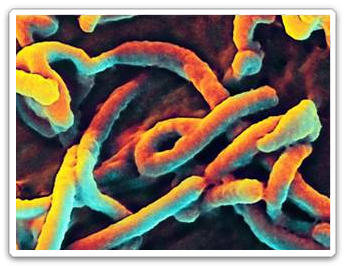
Image Content Provider: CDC Public Health Image Library
- Orthoebolaviruses do not spread easily from person to person. It is not spread through casual contact and is not transmitted until the infected person shows signs of illness. The infection spreads by contact with body fluids (e.g. blood, vomit and feces) of a person who is sick with or has died from EBOD; by contact with objects, surfaces or medical equipment that was in contact with infected body fluids (e.g. needles, clothes or bedding); or by close contact with infected animals or their body fluids (e.g. bats, monkeys and apes). No animals in Canada have been found to be naturally infected with orthoebolaviruses.
- Occasionally, there are outbreaks of EBOD, which have historically occurred mostly on the African continent.
- Travel to a country actively affected by an outbreak may put a person at risk.
- Risk from travel to any other country is very low unless the individual has been in contact with a person with EBOD.
- The risk of a case of EBOD in Manitoba is low.
On This Page:
- 2026 Outbreak of Ebola Disease
- Symptoms
- Causes
- Transmission
- Risk Groups
- Diagnosis and Treatment
- Prevention
- Resources For the Public
- Resources For Health Care Providers
- Other Resources
- Information for Travelers
2026 Outbreak of Ebola Disease
Updated: June 2, 2026
An outbreak of EBOD caused by Bundibugyo virus was declared in the Democratic Republic of Congo (DRC) on May 15, 2026. The World Health Organization (WHO) declared this outbreak a Public Health Emergency of International Concern (PHEIC) on May 17, 2026. The public health risk in Canada and Manitoba remains very low.
Further information on the outbreak is available at https://www.who.int/emergencies/disease-outbreak-news.
On May 26, 2026, the Government of Canada introduced temporary border measures to reduce the risk of the virus entering and spreading within Canada. Refer to Government of Canada introduces temporary border measures in response to the Ebola disease outbreak - Canada.ca for more information. Anyone who has been in the areas listed by the Government of Canada within the previous 21 days are advised to call Health Links-Info Santé at 204-788-8200 or 1-888-315-9257 (toll-free) to notify public health and for further public health advice.

Symptoms
EBOD is a serious illness that was first discovered in a remote part of Central Africa in 1976. Symptoms of EBOD include fever, tiredness, muscle aches, weakness, severe headache, red eyes, sore throat, vomiting and diarrhea that can be bloody, and bleeding. Symptoms develop rapidly. Fever is usually the first symptom of EBOD. This is followed by the sudden onset of flu-like symptoms followed by worsening gastrointestinal (i.e. vomiting and diarrhea) symptoms. EBOD can also cause kidney and liver problems. When the disease progresses, there may be a rash and bleeding from inside and outside the body. EBOD can cause death but early medical care increases the chances of survival.
Symptoms start between two to 21 days after contact with the virus. Infected persons are not contagious before symptoms start.
Before seeking health care, it is important to first call public health or Health Links-Info Santé at 204-788-8200 or 1-888-315-9257 (toll-free) if you or a household member has any of symptoms of EBOD and have travelled to an area with EBOD in the last 21 days or have been exposed to someone with EBOD in the last 21 days. Describe your symptoms over the phone, tell them where you have been travelling or living and mention any possible exposure risks. They will be able to advise you on next steps to get assessed and ensure precautions are taken to limit exposure to others by following protocols designed to minimize risk. In addition, if you suspect you have been exposed to EBOD, you should immediately isolate from household members and pets, wash your hands frequently and ensure no one comes in contact with your bodily fluids or items that may have touched your bodily fluids (e.g. bedding, toiletries).
In case of a medical emergency, when you call 911, make sure to let them know about any possible exposure risk to EBOD.
Causes
Outbreaks of EBOD have occurred from time to time in sub-Saharan Africa. There are six recognized species of Orthoebolavirus:
- Bundibugyo virus (BDBV)
- Ebola virus (EBOV, previously Zaire ebolavirus)
- Sudan virus (SUDV)
- Taï Forest virus (TAFV)
- Bombali virus (BOMV)
- Reston ebolavirus (RESTV)
Of the six species, only the first four are known to cause illness in people. The EBOV and SUDV are considered especially virulent and associated with higher fatality rates. These viruses can cause disease in humans and non-human primates (e.g. monkeys, gorillas, chimpanzees) and can infect other animals (e.g. fruit bats, forest antelope, pigs). While the natural reservoir of EBOD is unknown, some bat species are suspected to carry the virus. Additionally, non-human primates have been identified as incidental hosts (not reservoirs).
Transmission
EBOD is not easily spread to other people. It spreads:
- from person to person by:
- direct contact with blood and/or other bodily fluids such as feces, urine, vomit, saliva, sweat, breast/chestmilk and semen from an infected, symptomatic person or dead body and/or;
- unprotected sexual contact with a person who is recovering from EBOD for up to 12 months following infection.
- through contact with surfaces or equipment (e.g. needles) that are contaminated with infected body fluids, and
- through close contact (e.g. handling or eating) with live or dead infected animals or their body fluids.
Cases can spread the virus as long as their blood and/or other bodily fluids contain the virus, including after death.
EBOD is not spread through the air, by water, or in general, by food. However, in Africa, EBOD may be spread by handling bushmeat (wild animals hunted for food).
You can't get EBOD from people who have no symptoms, even if they were recently in an affected country.
Just because someone who has recently been to an affected country is sick, it doesn't mean they have EBOD.
Risk Groups
The following activities have a higher risk of exposure to EBOD:
- Caring for an EBOD case who is symptomatic without proper and consistent appropriate use of personal protective equipment (PPE)
- Unprotected sexual contact with a person infected with EBOD who is ill or after recovery for up to 12 months
- During pregnancy or birth, if the birth parent has EBOD
- Breast/chestfeeding, if the parent has EBOD
- Participating in unsafe burial practices, including preparing the body for burial
- Travel to an area affected by EBOD, including staying in a community with active spread of EBOD, and
- Handling and/or consuming wild animals (i.e. bushmeat) in EBOD affected areas
Diagnosis and Treatment
EBOD is diagnosed by a laboratory test, usually a blood test. It is important to have an early diagnosis because people can recover from EBOD when they receive timely medical care for their symptoms. The average case fatality rate for EBOD is 50%. Case fatality rates have varied from 25% to 90% in past outbreaks.
There are currently no approved treatments available for EBOD in Canada. Cases receive care in specialized health centres and receive supportive care, such as intravenous fluids, oxygen, blood products, and treating other infections if they occur.
A number of investigational treatments and vaccines are currently under development for some of the different species of orthoebolaviruses. If a case occurs in Canada, the Public Health Agency of Canada (PHAC), in coordination with the province or territory, will provide guidance and access to investigational products as required and appropriate for the situation.
Prevention
In Canada, there is currently one vaccine authorized for use. Ervebo® (EZV) is only effective against EBOV and is not effective against the other species of orthoebolaviruses. It is not recommended as part of routine immunization programs or prior to travel. However, it is available to help control an outbreak in Canada for those with the highest risk of exposure.
EBOD prevention measures include:
- avoiding direct contact with blood and body fluids from a person infected with EBOD
- avoiding non-essential travel to regions affected by ongoing EBOD outbreaks.
- avoiding contact with items that may have come in contact with an infected person's blood or body fluids (such as clothes, bedding, needles, and medical equipment).
- avoiding funeral or burial practices that involve touching the body of someone who died from confirmed or suspected EBOD.
- avoiding contact with bats, forest antelopes, and nonhuman primates (such as monkeys and chimpanzees) blood, fluids, or raw meat prepared from these or unknown animals (bushmeat).
After returning from an area experiencing an EBOD outbreak, people should monitor their health for 21 days. Individuals who are known to be exposed are monitored by public health for 21 days.
Resources
For the Public
For Health Care Providers
-
Update on the Ebola Disease Outbreak in Democratic Republic of the Congo and Uganda

(August 2026) -
Ebola Disease (EBOD) - CD Management Interim Protocol
(May 2026) -
Update on international Ebola disease and hantavirus outbreaks
(May 2026) - Emergency & Continuity Management (ECM) - Shared Health (includes High Consequence Pathogen documents & resources)
-
Infection prevention and control measures for Ebola disease in acute care settings - Canada.ca
(June 2023) -
Infection Prevention and Control Measures for Prehospital Care and Ground Transport of Persons Under Investigation for Ebola Disease or with Confirmed Ebola Disease - Canada.ca
(June 2023) -
Measures for the management of Ebola virus disease-associated waste and linen in home settings - Canada.ca
(February 2015)
Other Resources
- Government of Canada – Ebola Virus Disease
- Government of Canada – Ebola Virus Disease Prevention, Monitoring and Surveillance Recommendations
- Centers for Disease Control and Prevention – Ebola Virus Disease
- World Health Organization – Ebola Virus Disease
Information for Travelers
Communicable Disease Control (CDC)
Public Health
Manitoba Health
4th Floor - 300 Carlton St.
Winnipeg MB R3B 3M9 CANADA
Health Links – Info Santé
204-788-8200 or 1-888-315-9257
